
What if the next generation of sewage treatment plants is not designed simply to treat waste, but to recover water, energy and resources?
The STP Is Ready for a New Role
For decades, the sewage treatment plant has been treated as the end point of the wastewater journey. Sewage comes in, pollutants are removed, treated water goes out — and the plant does its job.
But that model is beginning to look incomplete.
What if wastewater is not the waste stream, but the raw material?
Every STP receives a mix of water, organic matter, nutrients and other recoverable resources. With the right treatment technologies, some of these can be recovered and put to productive use.
Treated wastewater can become a dependable source for non-potable applications. Organic matter can generate biogas. Sludge can be processed rather than simply disposed of. Nutrients can potentially be recovered.
The opportunity is significant because cities and industries are facing the same pressures from different directions: water scarcity, rising operating costs, tighter environmental expectations and the need to do more with existing infrastructure.
This is where the concept of resource recovery changes the conversation.
PULL QUOTE
“The question is no longer only how efficiently we treat wastewater. It is how much value we can recover from it.”
From STP to Resource Recovery Facility
The conventional STP is primarily designed around pollutant removal. A resource recovery facility takes a broader view of what happens inside the plant.
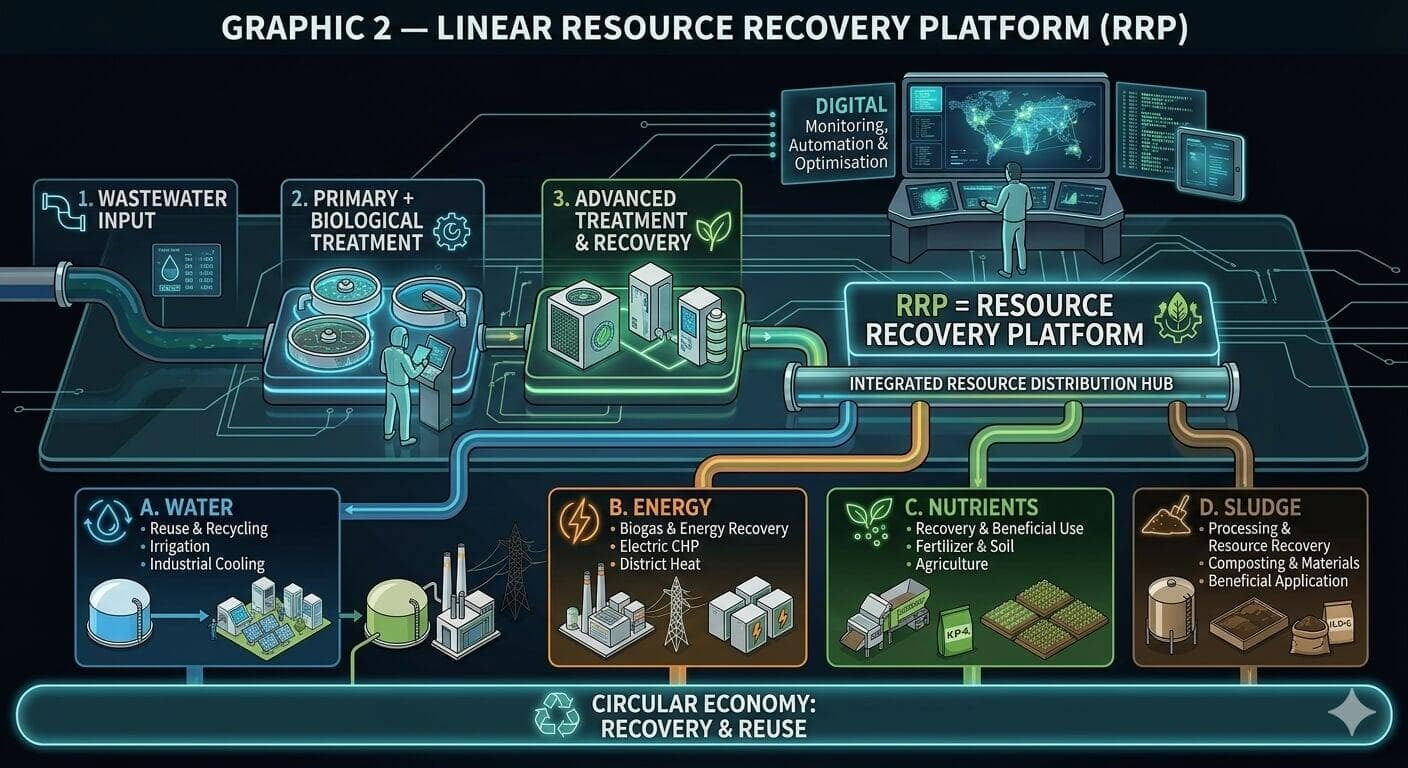
Treatment technologies can be combined with systems for water reuse, anaerobic digestion, biogas recovery, sludge processing, nutrient recovery, membrane treatment and digital monitoring.
The result is potentially a facility with several useful outputs rather than a single treatment objective.
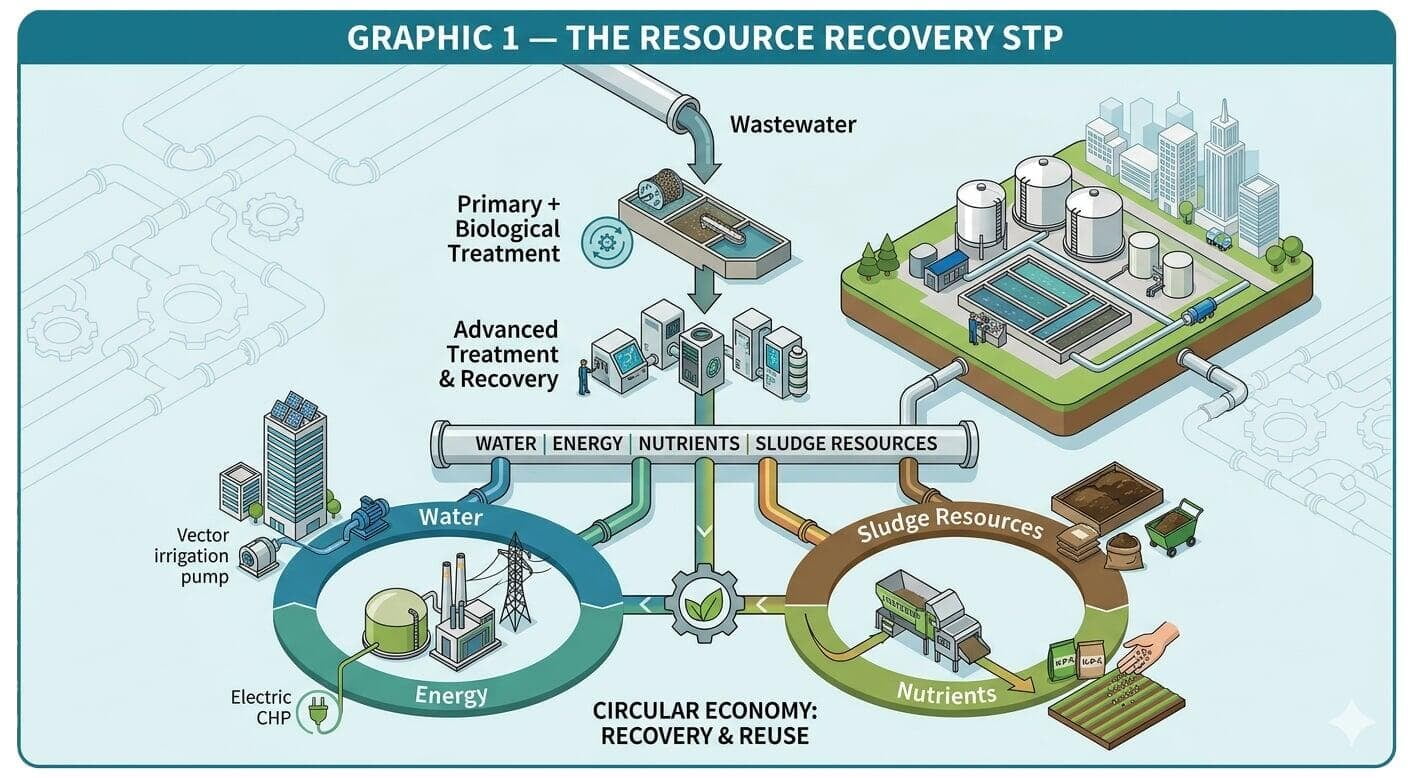
The modern STP can become a multi-output facility when treatment and resource recovery are planned together.
Water: The Most Valuable Resource to Recover
For water-stressed cities and industries, the most immediate opportunity is water reuse.
The larger challenge is scale.
Depending on treatment quality, reclaimed water can serve applications such as cooling, flushing, landscaping, construction and selected industrial processes.
For industry, this can reduce dependence on freshwater sources. For cities, it can create an additional water resource without placing further pressure on conventional supplies.
But water reuse does not end at the treatment plant.
It requires quality assurance, storage, distribution networks, monitoring and — most importantly — a reliable user.
BLURB
The opportunity is not simply to produce treated water. It is to build a reliable market and infrastructure around its reuse.
Energy Recovery: Turning Organic Waste into Value
Wastewater treatment consumes energy, making energy efficiency a major consideration in STP operations.
This is also where resource recovery offers an interesting opportunity.
Through anaerobic digestion, organic matter in sludge can be converted into biogas. Depending on the scale and system design, biogas can support heat or power generation and potentially be upgraded for other applications.
The implication is important.
Sludge does not always have to be viewed only as a disposal challenge. It can also be viewed as an energy resource.
When combined with efficient aeration, pumping and process control, energy recovery can contribute to improving the overall operating economics of a facility.
Chennai and Tamil Nadu: Where the Opportunity Gets Real
For Chennai, this discussion has particular relevance.
The city has a long-standing need to strengthen water security while managing growing urban demand. At the same time, wastewater is being generated continuously across residential, commercial and industrial areas.
Tamil Nadu's industrial ecosystem adds another dimension.
Automotive, electronics, chemicals, textiles, food processing, pharmaceuticals and other industries require dependable water supplies. Industrial estates and manufacturing clusters therefore represent potential users of treated wastewater where the required quality, economics and supply reliability can be achieved.
This creates a wider market opportunity.
It is not only about STP equipment.
It is not only about STP equipment.
It extends to membrane and filtration technologies, automation, sensors, energy recovery, sludge management, digital monitoring, O&M and treated-water distribution.
PULL QUOTE
“For Chennai and Tamil Nadu, wastewater can become part of a larger urban-industrial water strategy — not simply a disposal problem.”
The Industry Opportunity Is Bigger Than the Treatment Plant
The next wave of wastewater investment will require an ecosystem of technologies and services.
Technology providers will increasingly be expected to answer questions beyond treatment efficiency:
- How much water can actually be reused?
- What quality can consistently be achieved?
- What is the lifecycle cost?
- How much energy does the system consume?
- Can energy or other resources be recovered?
- How can sludge volumes and disposal costs be reduced?
- Can plant performance be monitored digitally?
- Who will use the recovered water or resources?
These questions are pushing the industry from equipment supply towards performance, efficiency and outcomes.
What Will Make Resource Recovery Commercially Viable?
Technology by itself will not make resource recovery successful.
Five factors will determine whether projects work commercially:
1. Reliable wastewater supply
The quantity and characteristics of the incoming wastewater must be understood.
2. Appropriate technology
The solution must match the application rather than simply maximise treatment complexity.
3. A defined end user
Recovered water, energy or other resources need a viable application or off-take.
4. Lifecycle economics
CAPEX is only part of the equation. Energy, chemicals, maintenance and replacement costs matter equally.
5. Strong O&M
Resource recovery systems need consistent operation, monitoring and performance management.
PULL QUOTE
“The winning STP will not necessarily be the one with the most technology. It will be the one that creates the most useful value from every part of the wastewater stream.”
A Platform to See Where the Industry Is Heading
For industries evaluating their next wastewater investment, keeping pace with these developments is becoming increasingly important.
Water Today’s Water Expo Chennai 2027, the 20th edition of the show, will bring together water and wastewater technology providers, OEMs, solution companies, industry professionals and decision-makers under one platform.
For industrial users, the exhibition provides an opportunity to see technologies first-hand, compare solutions, understand new applications and engage directly with technology providers.
The International Water Conference will add another layer to that experience, bringing industry experts and sector stakeholders together to discuss emerging technologies, water security, reuse, resource recovery and the changing priorities of the water sector.
For companies looking beyond conventional wastewater treatment, the value of attending is not simply in discovering products.
It is in understanding where the technology is heading — and what it could mean for their own operations.
WHY VISIT?
EVENT BLURB
Water Today’s Water Expo Chennai 2027 offers industry an opportunity to move beyond the traditional STP conversation — from treatment and compliance to reuse, recovery, efficiency and resource value.